

VPN vs Proxy: Key Differences, Security and Privacy
Zafruddin Shaik
Cybersecurity
Published on
5 min read
When browsing the internet, protecting your privacy and managing your online connection can be important. Two tools often discussed for these purposes are Virtual Private Networks (VPNs) and proxy servers. Both can route internet traffic through another server and may hide your original IP address from the websites you visit, but they work differently and offer different levels of protection. Understanding the difference between a VPN and a proxy can help you choose the right option for your needs. This guide explains how each works, their main advantages and limitations, and what to consider before using either service.
What Is a VPN?
A Virtual Private Network (VPN) creates an encrypted connection between your device and a VPN server. Your internet traffic travels through this connection before reaching its destination. Websites generally see the VPN server's IP address instead of your original public IP address. One of the main benefits of a VPN is that it encrypts the traffic carried between your device and the VPN server. This can help protect your information from being read by people monitoring the local network, particularly when you use public Wi-Fi. VPN applications are available for computers, smartphones and other supported devices. Depending on the service and configuration, a VPN can route traffic from multiple applications through the encrypted connection. However, it does not make you completely anonymous or protect you from every online threat.
What Is a Proxy Server?
A proxy server acts as an intermediary between your device and another online service. Instead of connecting directly to a website, your request passes through the proxy server, which forwards it to the destination. The website may see the proxy server's IP address rather than your original public IP address. However, the level of privacy depends on the proxy type, its configuration and how the destination handles your connection. Unlike a typical VPN, a basic proxy does not necessarily encrypt your traffic. Some proxies handle requests from a particular application or browser rather than routing traffic from the entire device. HTTPS can still encrypt the connection between your browser and a website, but that protection comes from HTTPS, not automatically from the proxy itself.
VPN vs Proxy: Key Differences
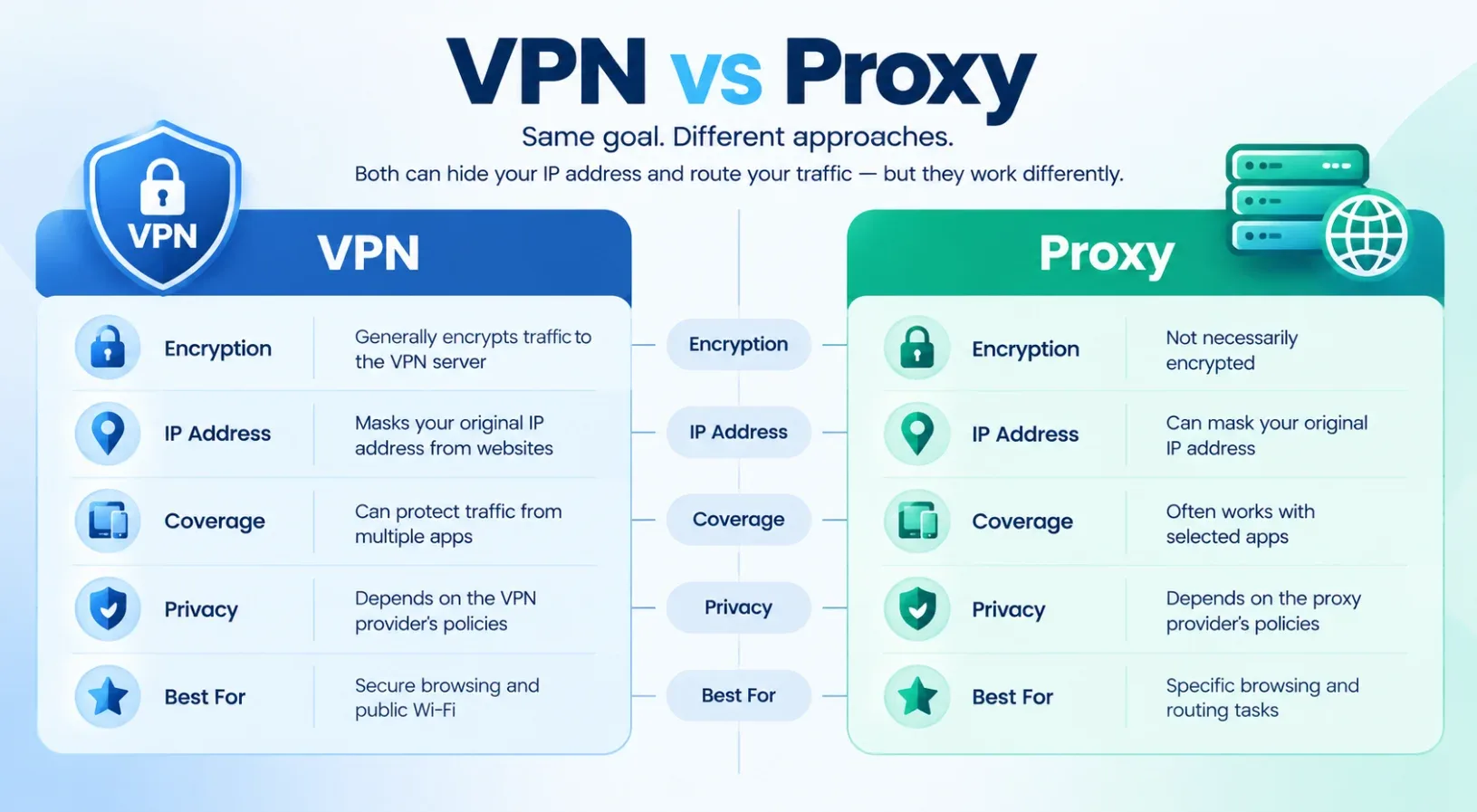
Although VPNs and proxies can both route traffic through another server, their features and intended uses differ.
1. Encryption and Security
A VPN generally encrypts traffic between your device and the VPN server. This provides an additional layer of protection on networks you do not fully trust. A proxy, particularly a basic one, may simply forward requests without encrypting the connection between your device and the proxy. If encryption is important, check the specific service's security features instead of assuming every proxy offers the same protection.
2. Privacy and IP Address Masking
Both tools can make websites see an intermediary server's IP address rather than your original public IP address. However, neither guarantees complete anonymity. A VPN can protect traffic carried through its encrypted tunnel, while a proxy's protection depends on its type and configuration. Both services may have access to certain connection information, so reviewing their privacy policies is important.
3. Device and Application Coverage
Many VPN applications can route traffic from most applications on a device, depending on the operating system and settings. This makes them useful when you want broader coverage rather than configuring each application separately. Proxies are often configured for a specific browser or application. Some systems can route more traffic through a proxy, but coverage depends on the setup.
4. Speed and Performance
Neither option is always faster. Performance depends on server distance, network congestion, encryption overhead, the provider's infrastructure and your internet connection. A simple proxy may introduce less processing overhead than a VPN, but an overloaded or distant proxy can still be slow. A well-maintained VPN server may perform better than a poorly maintained proxy.
When Should You Use a VPN?
A VPN may be a suitable choice when you want an encrypted connection for traffic passing through public Wi-Fi or when you need to route traffic from multiple applications through a single service. It can also support secure remote access to workplace resources when configured for that purpose. Before choosing a provider, compare its supported protocols, privacy policy, server locations, connection performance and device compatibility. Remember that a VPN does not prevent all tracking, phishing or malware. Strong passwords, multifactor authentication, software updates and careful browsing remain important.
When Should You Use a Proxy?
A proxy may be useful when you need to route traffic from a particular browser or application through another server. Some users also configure proxies for specific network tasks or testing purposes. However, a proxy is not automatically a substitute for a VPN. Before using one, check whether the connection is encrypted, what information the provider collects and whether the service is trustworthy. Avoid entering sensitive information through an untrusted proxy, especially if it can inspect unencrypted traffic. Free proxy services deserve particular caution because their privacy practices, reliability and security features may be unclear.
VPN vs Proxy: Which One Is Better?
The right choice depends on your goal. If you want an encrypted connection between your device and a remote server, a reputable VPN is generally the more comprehensive option. If you only need to route traffic from a particular application and understand the proxy's limitations, a proxy may be sufficient. Neither tool guarantees anonymity or makes unsafe websites trustworthy. Consider your privacy requirements, the information you handle and the provider's security practices before deciding.
Final Thoughts
The main difference between a VPN and a proxy is how they handle traffic and what protection they provide. A VPN typically creates an encrypted tunnel for the traffic it carries, while a proxy acts as an intermediary and may not encrypt the connection. Before choosing either option, review the provider's privacy policy, security features and intended use. Understanding these differences can help you make a more informed decision about your online privacy and connection security.
FAQs
1. Is a VPN better than a proxy?
For encrypted protection across supported device traffic, a VPN is generally the more comprehensive option. A proxy may be sufficient for specific application-level routing, depending on its configuration and your needs.
2. Does a proxy hide my IP address?
A proxy can make websites see the proxy server's IP address instead of your original public IP address. However, the result depends on the proxy configuration, and it does not guarantee anonymity.
3. Does a proxy encrypt internet traffic?
Not necessarily. Basic proxies may forward traffic without encrypting the connection between your device and the proxy. HTTPS can protect traffic between your browser and a website independently.
4. Can I use a VPN and a proxy together?
Yes, some configurations allow both, but setup can be more complicated and may affect connection speed. The benefits depend on how the services are configured.
5. Is a free proxy safe to use?
Not always. Free proxy services vary in reliability, privacy practices and security. Review the provider's policies and avoid sending sensitive information through an untrusted service.