


VPN vs Tor: What's the Difference? Privacy and Security Guide
Zafruddin Shaik
Cybersecurity
Published on
5 min read
Online privacy has become increasingly important as people browse websites, use public Wi-Fi, work remotely, and share information online. Two tools often discussed for improving privacy are Virtual Private Networks (VPNs) and Tor. Both can help make certain aspects of your internet activity harder to monitor, but they work differently and serve different purposes. Understanding the difference between a VPN and Tor can help you choose the right option for your browsing habits, privacy needs, and connection preferences.
What Is a VPN?
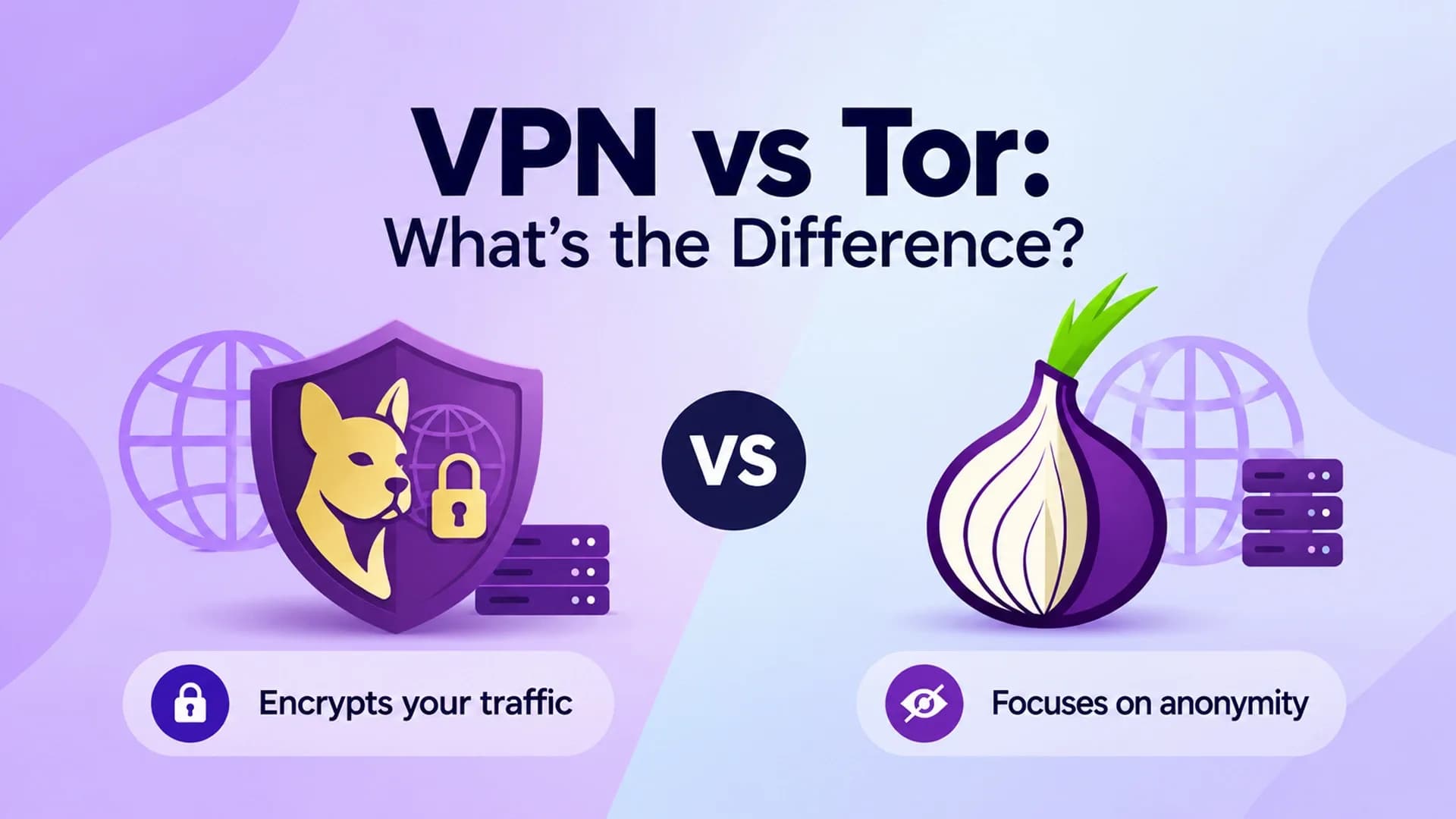
A Virtual Private Network (VPN) creates an encrypted connection between your device and a VPN server. Your internet traffic travels through this connection before reaching its destination. When you use a VPN, websites generally see the VPN server's public IP address instead of your original public IP address. Encryption also helps protect your traffic from being read by other parties monitoring your local network. VPNs are commonly used for everyday browsing, remote work, and adding privacy when connecting to public Wi-Fi. However, the VPN provider becomes an important part of your privacy setup because it may have access to certain connection information depending on its technology and logging practices.
What Is Tor?
Tor, short for The Onion Router, is a network designed to improve privacy by routing internet traffic through multiple volunteer-operated relays. Instead of relying on a single VPN server, Tor typically routes traffic through three relays: an entry relay, a middle relay, and an exit relay. Encryption is layered so that each relay handles only the information needed to pass traffic along the route. This design helps separate your original IP address from the destination website. The entry relay can see your IP address but does not normally know the final destination, while the exit relay connects to the destination but does not normally know your original IP address. Tor is often used for privacy-sensitive browsing and accessing websites without directly revealing a user's usual public IP address. However, it does not protect every application automatically, and its performance can be slower than a typical VPN connection.
VPN vs Tor: Key Differences
1. How They Work
A VPN routes your traffic through a VPN server using an encrypted connection between your device and that server. Your VPN provider manages the server infrastructure. Tor routes traffic through multiple relays operated by different volunteers. Its layered routing system is designed to reduce the ability of a single relay to link your identity with your destination. The main difference is that a VPN relies on a provider, while Tor distributes trust across several relays.
2. Privacy and Anonymity
Both tools can help conceal your original IP address from destination websites, but neither guarantees complete anonymity. With a VPN, you shift some trust from your internet service provider to the VPN provider. The provider's privacy policy, technical design, and logging practices therefore matter. Tor is designed to make it harder to link the user with their destination through a single point of observation. Nevertheless, sophisticated traffic-correlation attacks, browser fingerprinting, account logins, and unsafe browsing habits can still compromise privacy.
3. Speed and Performance
VPNs are generally more convenient for everyday activities because traffic usually passes through one VPN server. Actual speeds depend on server distance, congestion, encryption overhead, and your original internet connection. Tor traffic travels through multiple relays, which can introduce additional latency. As a result, browsing may feel slower, especially when loading media-heavy websites or using real-time applications.
Neither tool guarantees a particular connection speed.
4. Security and Encryption
A VPN encrypts traffic between your device and the VPN server. Traffic beyond that server is subject to the security of the destination connection, such as HTTPS. Tor uses layered encryption between the user and the Tor relays. However, traffic leaving a Tor exit relay may be visible if the destination connection is not independently encrypted. For this reason, HTTPS remains important when using either tool. Both VPNs and Tor also have limitations when it comes to malware, phishing, compromised devices, and information you voluntarily share online.
5. Ease of Use
VPN applications are generally straightforward to use. You typically install the app, select a server, and connect. Many services support computers, smartphones, and other compatible devices. Tor Browser is designed to make browsing through the Tor network accessible without requiring users to configure individual relays. However, users need to follow its security recommendations and avoid changing settings without understanding the consequences. For most everyday users, a VPN may feel more convenient. Tor may be more suitable when its particular anonymity design is important.
VPN vs Tor: Which One Should You Choose?
The right choice depends on your priorities.
Choose a VPN if you want to:
- Encrypt your connection on public Wi-Fi.
- Mask your public IP address from destination websites.
- Use a convenient privacy tool across supported devices.
- Connect to VPN servers in different locations, subject to service rules and local laws.
Consider Tor if you want to:
- Browse through a decentralised, multi-relay network.
- Reduce the ability of a single network intermediary to link your identity with your destination.
- Use Tor Browser for privacy-sensitive browsing.
- Avoid relying on one VPN provider for your browsing connection.
Some people use Tor and a VPN together, but combining them does not automatically improve security in every situation. The order of connection, configuration, and threat model matter, and incorrect setups can create additional risks.
Final Thoughts
The main difference between a VPN and Tor is how each routes your traffic and where trust is placed. A VPN offers an encrypted connection through a provider-managed server, while Tor routes traffic through multiple relays to improve anonymity. A VPN is often practical for everyday privacy and public Wi-Fi protection. Tor is designed for users who need its multi-relay anonymity model and are comfortable with its limitations. Whichever option you choose, keep your software updated, use HTTPS, avoid suspicious links, and remember that no privacy tool can eliminate every online risk.
FAQs
1. Is Tor better than a VPN for privacy?
Not in every situation. Tor is designed to provide stronger separation between a user's identity and destination through multiple relays, while a VPN offers a convenient encrypted connection through a provider. The better option depends on your needs and threat model.
2. Can I use Tor and a VPN together?
Yes, but the setup requires care. Combining them does not automatically make you safer and may affect performance or create configuration risks. Understand your privacy requirements before combining the two.
3. Is Tor slower than a VPN?
Tor is often slower because traffic passes through multiple relays. VPN performance depends on factors such as server distance, network congestion, and your internet connection.
4. Does a VPN make me anonymous online?
No. A VPN masks your original public IP address from destination websites and encrypts traffic to its server, but accounts, cookies, browser fingerprinting, and provider data practices can still affect privacy.
5. Is Tor safe to use?
Tor can improve privacy when used correctly, but it does not prevent every threat. Use the official Tor Browser, follow its security guidance, and avoid sharing identifying information or opening suspicious files.